Mia Schmidt · 10 October 2026
Managing Note Version Histories Across Distributed Cloud Environments in Annotation Software
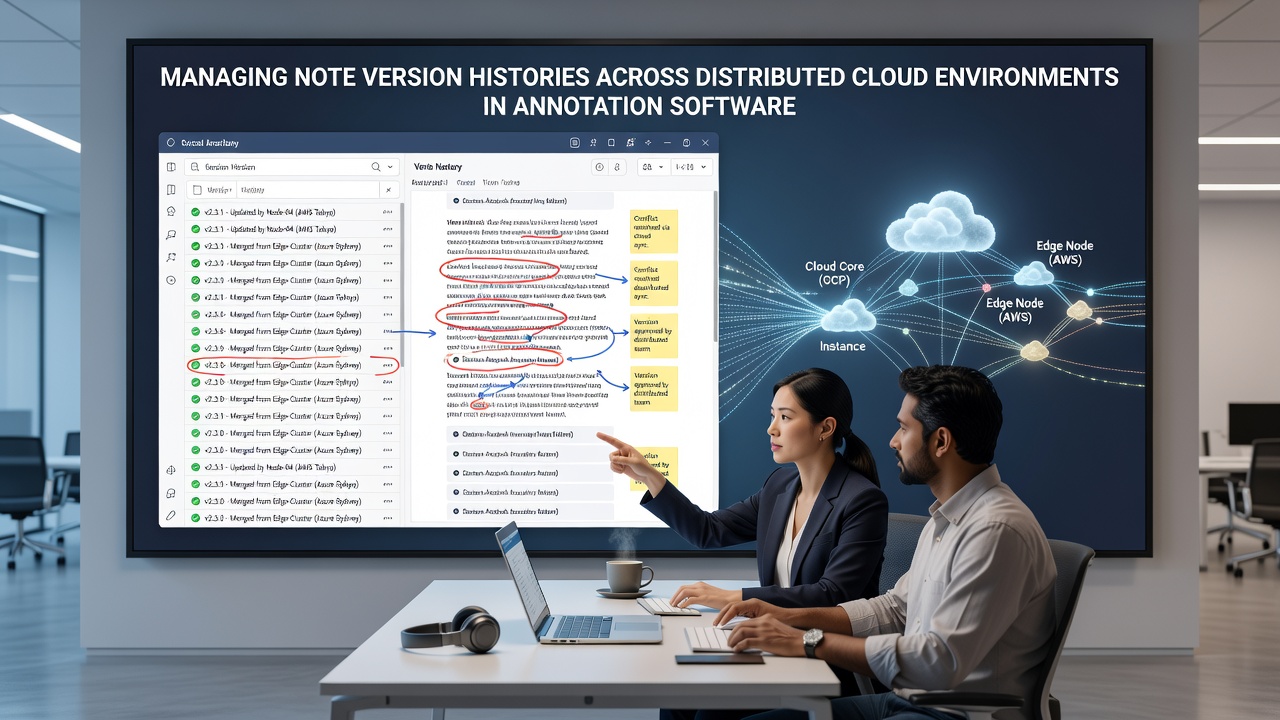
Annotation software has expanded to handle collaborative editing across multiple cloud providers, and version histories now require precise tracking to maintain consistency when notes move between data centers in different geographic zones. Systems store each annotation change as a discrete event with timestamps, user identifiers, and metadata that allow reconstruction of prior states even when the underlying infrastructure spans AWS, Azure, and regional providers simultaneously.
Core Components of Version History Management
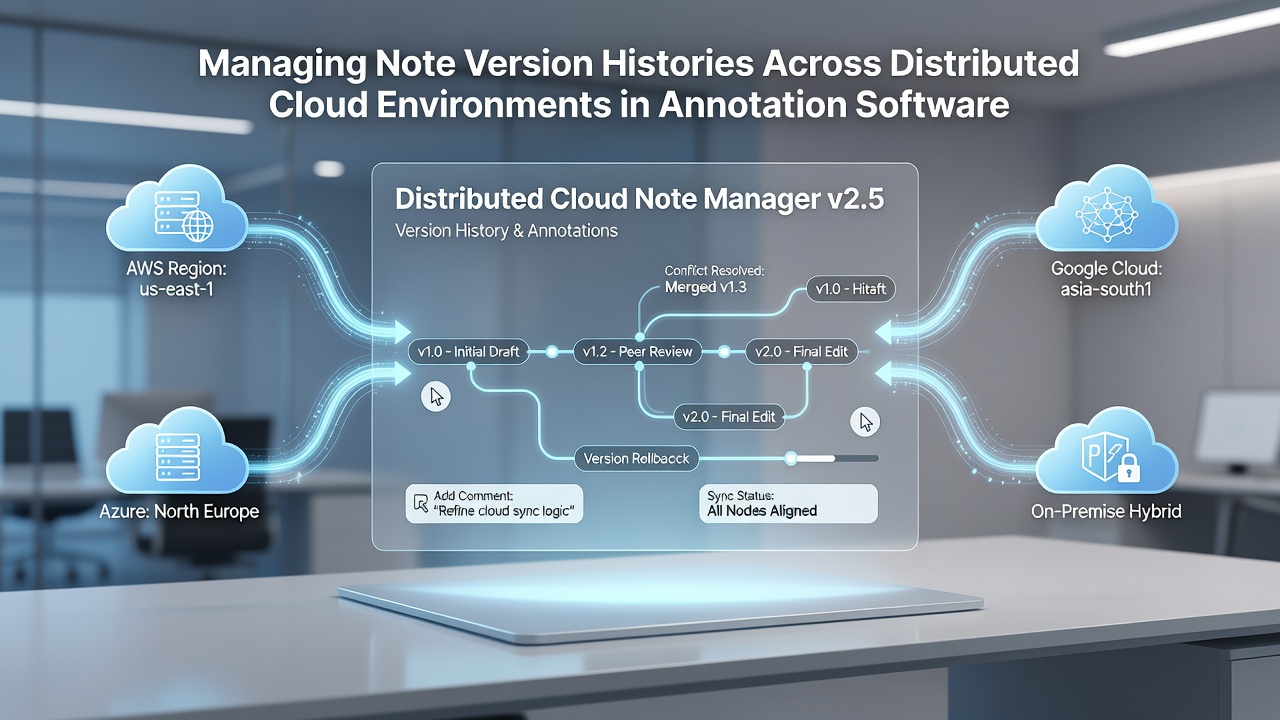
Distributed environments rely on event sourcing patterns where every modification to a note generates an immutable record that gets replicated across nodes, and these records include vector clocks or similar mechanisms to order changes that occur concurrently on separate continents. Software platforms apply Merkle trees to verify that all replicas hold identical version sequences before allowing a merge operation, which reduces the risk of silent data divergence during network partitions.
Researchers at institutions studying cloud-scale collaboration have documented how annotation layers accumulate metadata such as stroke coordinates, color values, and comment threads, each tagged with a unique revision identifier that persists even after infrastructure reallocations shift workloads between availability zones. Data from operational deployments shows that average note histories contain between 50 and 300 revisions per document when teams work across three or more cloud regions.
Synchronization Protocols and Conflict Handling
Protocols such as CRDTs and operational transformation enable multiple users to edit the same annotation set without locking resources, while the system records each operation so that later reconciliation produces a single coherent history. In October 2026 several annotation platforms began rolling out enhanced delta-compression techniques that cut bandwidth usage by storing only the differences between consecutive revisions rather than full snapshots, an approach validated in production environments handling millions of concurrent sessions.
Conflict detection occurs when vector clock comparisons reveal overlapping changes, after which the software presents users with a visual diff that highlights added or removed annotation elements, and automated resolution rules based on priority hierarchies or last-writer-wins can be configured per workspace. Observers note that organizations using policy-driven resolution report fewer manual interventions compared with earlier centralized systems.
Storage Strategies Across Multiple Providers
Storage architectures separate hot revision data, which remains in low-latency object stores near active users, from cold archives that move older versions to cost-optimized tiers on secondary clouds, and metadata indexes stay in globally replicated databases to support rapid lookup regardless of where the actual payload resides. Encryption keys rotate on a per-revision basis, and key management services from different vendors integrate through standardized APIs so that compliance requirements remain satisfied even when data crosses regulatory boundaries.
Figures from industry reports indicate that annotation platforms maintaining version histories across distributed clouds experience average replication latencies under 250 milliseconds between primary and secondary regions when using optimized gossip protocols, while full cross-cloud consistency checks complete within scheduled maintenance windows that occur weekly.
Compliance and Auditing Requirements
Regulatory frameworks in the European Union and Australia require retention of version histories for a minimum number of years depending on document type, and annotation software now embeds audit trails directly into each revision record so that access logs and change provenance can be exported without additional processing. ENISA guidelines on cloud data handling emphasize the need for immutable logs that survive provider-level failures, a requirement met by appending cryptographic hashes to every revision entry.
North American deployments often reference standards developed by national research agencies that specify how version metadata must be protected during transit between availability zones, ensuring that organizations can demonstrate chain-of-custody for sensitive annotations during audits.
Implementation Patterns Observed in Production
Teams deploying annotation software at scale frequently adopt a hybrid model where core version management logic runs in a control plane that spans multiple clouds, while the actual note payloads and their histories are sharded according to user proximity and data residency rules. One documented deployment at a multinational research consortium showed that switching from single-provider storage to a multi-cloud setup reduced recovery time after regional outages from hours to minutes because alternate replicas remained available for immediate failover.
Monitoring dashboards track metrics such as revision ingestion rate, merge conflict frequency, and cross-region replication lag, providing operators with real-time visibility into the health of the distributed history system. Automated alerts trigger when any metric exceeds thresholds established during initial capacity planning.
Conclusion
Effective management of note version histories in distributed cloud environments depends on combining event sourcing, conflict-free data structures, and layered storage policies that together preserve complete revision sequences regardless of infrastructure shifts. As annotation platforms continue to evolve through 2026 and beyond, the same foundational techniques support both collaborative workflows and regulatory compliance across geographic and provider boundaries.